Anatomy and Taxonomy of Agents
Objectives
Understand what AI agents are and their main components
Explore Mechanics of Agency and core anatomy of agents
Gain basic overview of Agent Ops concepts
References
The Paradigm Shift: From Predictive AI to Autonomous Agents
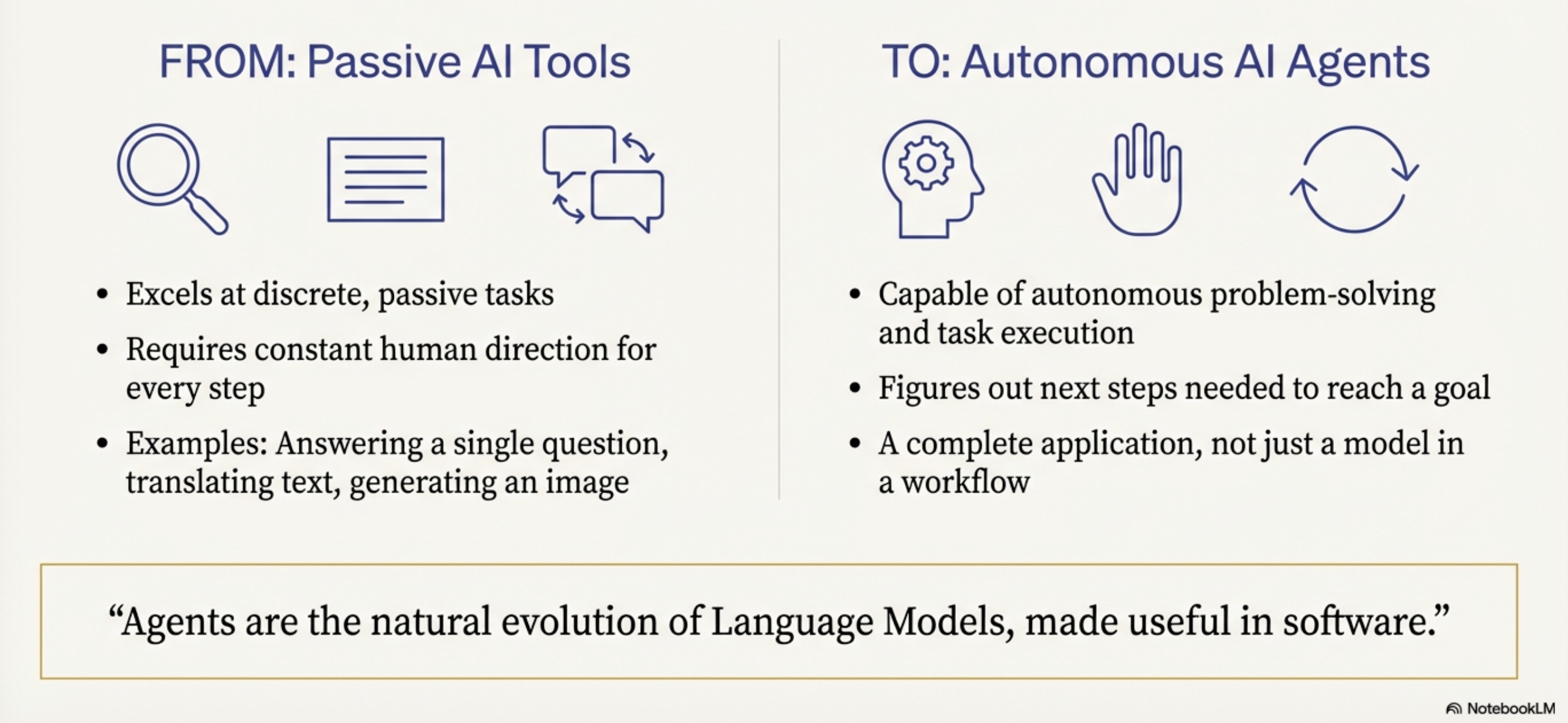
We are moving beyond “Predictive AI”—systems that operate in a passive, discrete paradigm to translate text or generate images—toward “Autonomous Agents”
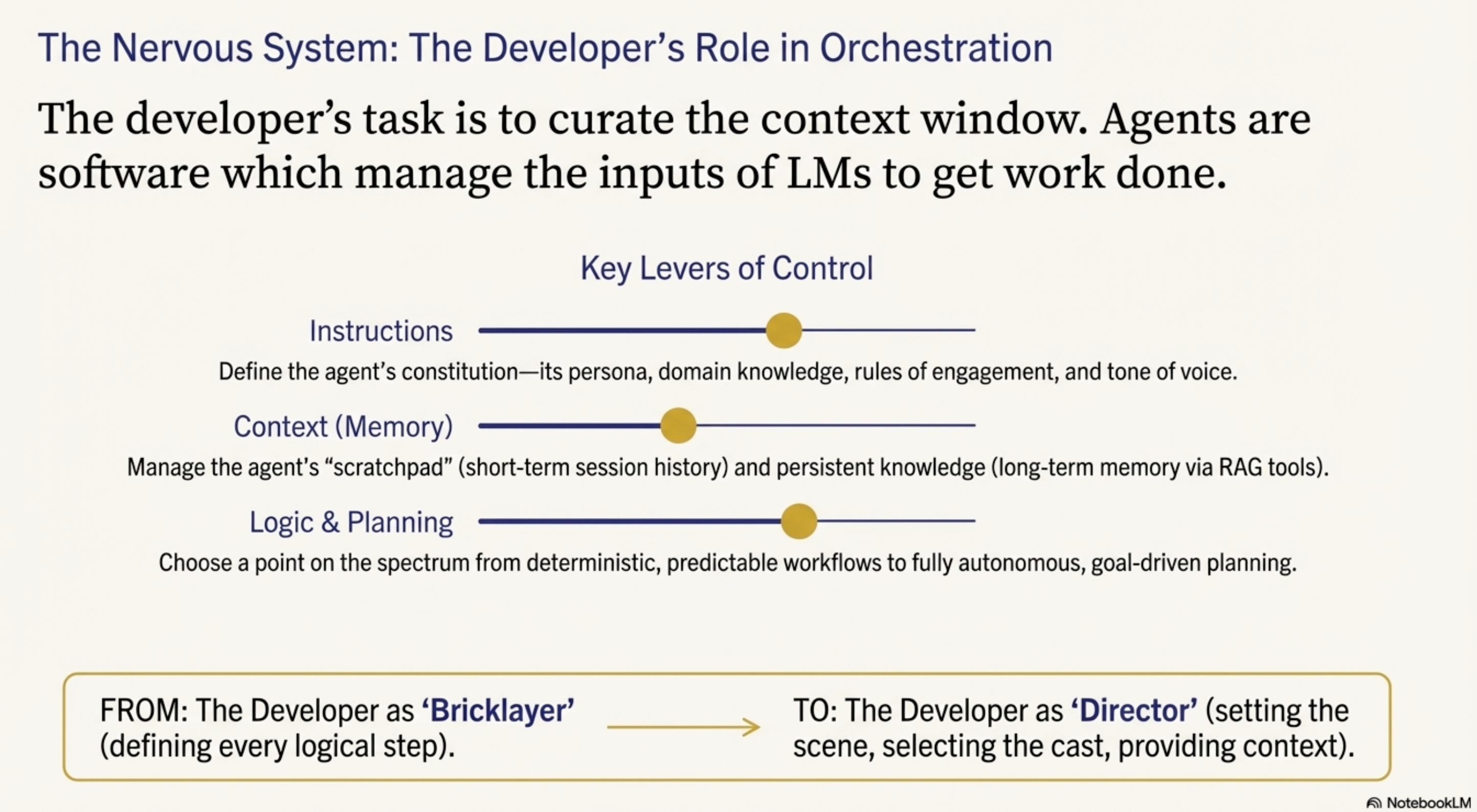
This shift represents a move from the traditional “bricklayer” development model, where engineers define every logical step via explicit code, to a “director” model
In this new era, the developer orchestrates an autonomous “actor” by
setting the scene through guiding instructions
selecting a cast of specialized tools, and
curating the necessary context to achieve high-level goals
Model-Centric vs. Agentic-Centric
Feature |
Model-Centric (Passive AI) |
Agentic-Centric (AI Agents) |
|---|---|---|
Autonomy |
Requires human direction for every discrete step. |
Capable of autonomous planning and multi-step execution. |
Task Handling |
Static workflows; input-to-output mapping. |
Complex, goal-oriented missions with dynamic adaptation. |
Execution Loop |
Linear (Input → Model → Output). |
Cyclical (Think → Act → Observe). |
Interaction |
Predictive or creative content generation. |
Practical agency; the ability to change the state of the world via tools. |
Defining the Agent
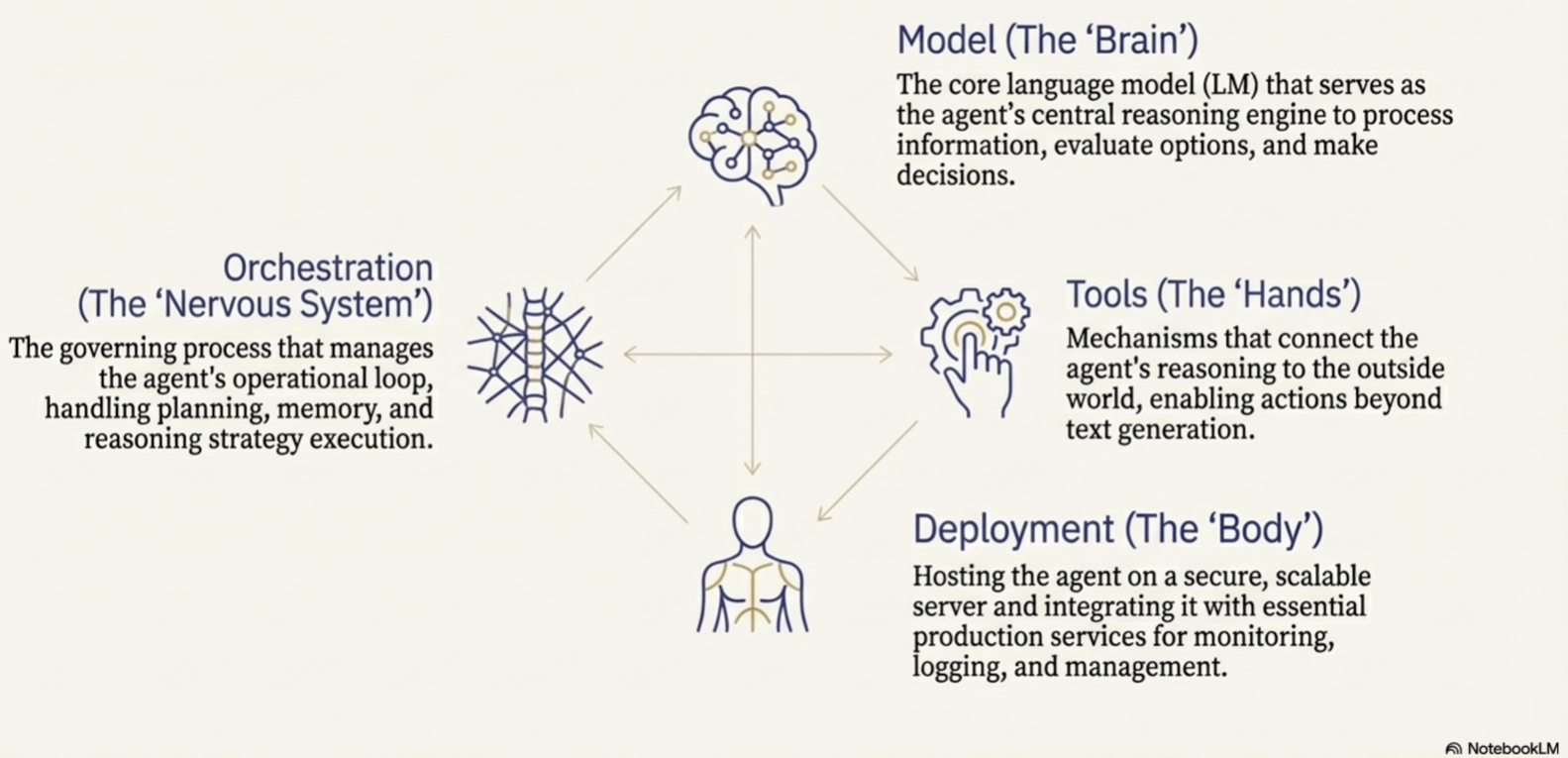
An agent is not merely a model
it is the natural evolution of Language Models (LMs) synthesized into functional software
Core components of an agent
The Model (The Brain)
The reasoning engine that processes information and makes decisions.
Tools (The Hands):
Interfaces (APIs, data stores) that connect reasoning to reality.
The Orchestration Layer (The Nervous System):
The state machine that manages the operational loop, memory, and strategy.
Runtime Services (The Body and Legs):
The production infrastructure (hosting, logging, monitoring) that ensures reliability and accessibility
Understanding this definition is the prerequisite for exploring how these systems systematically solve complex, non-deterministic problems.
The Mechanics of Agency: The 5-Step Operational Loop
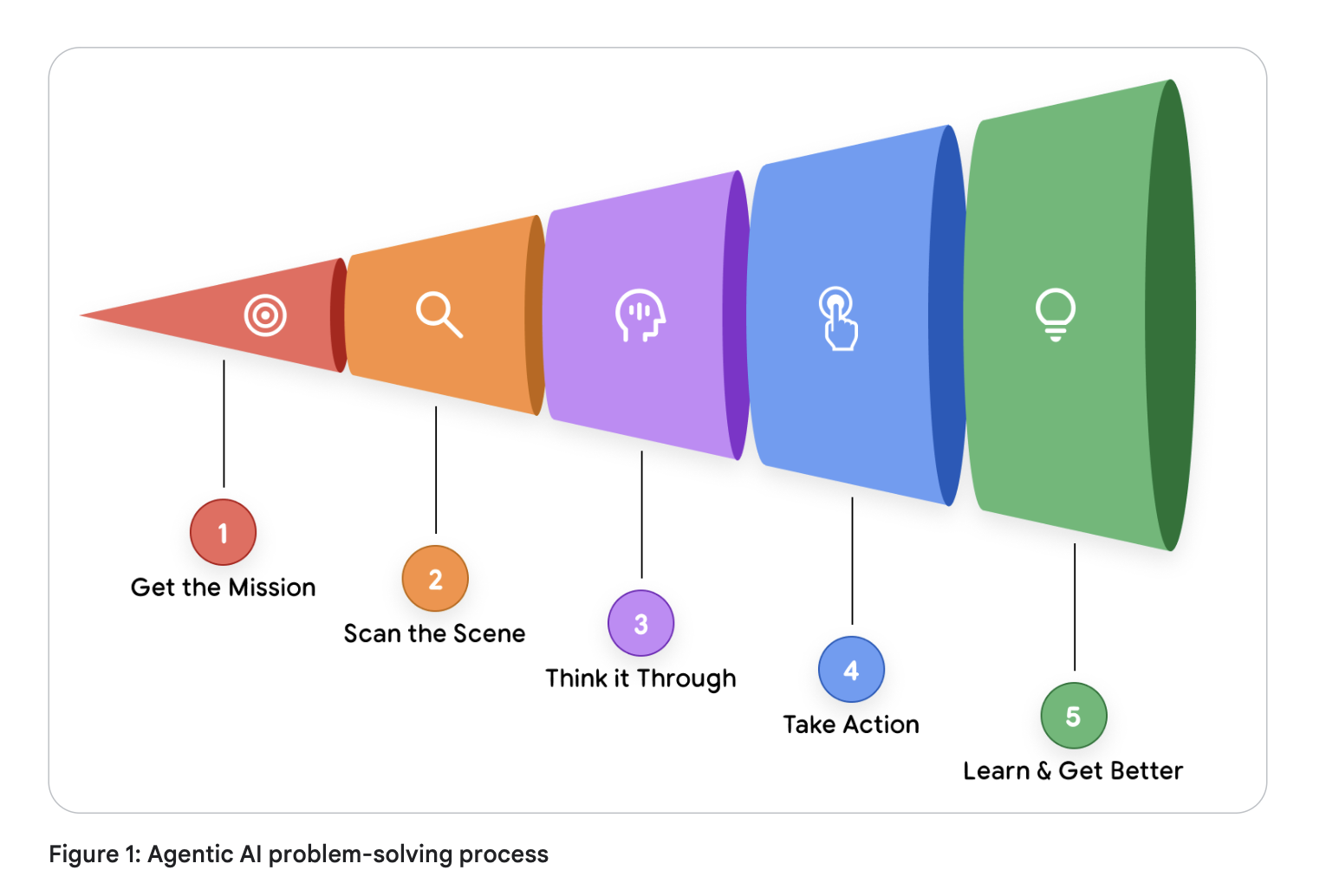 Source: Introduction to Agents; Authors: Alan Blount, Antonio Gulli, Shubham Saboo,
Michael Zimmermann, and Vladimir Vuskovic
Source: Introduction to Agents; Authors: Alan Blount, Antonio Gulli, Shubham Saboo,
Michael Zimmermann, and Vladimir Vuskovic
Maintain the assurance that the agent remains grounded in the mission despite the probabilistic nature of the underlying model. The “Think, Act, Observe” cycle allows for continuous refinement as the agent interacts with its environment
The 5-Step Cycle
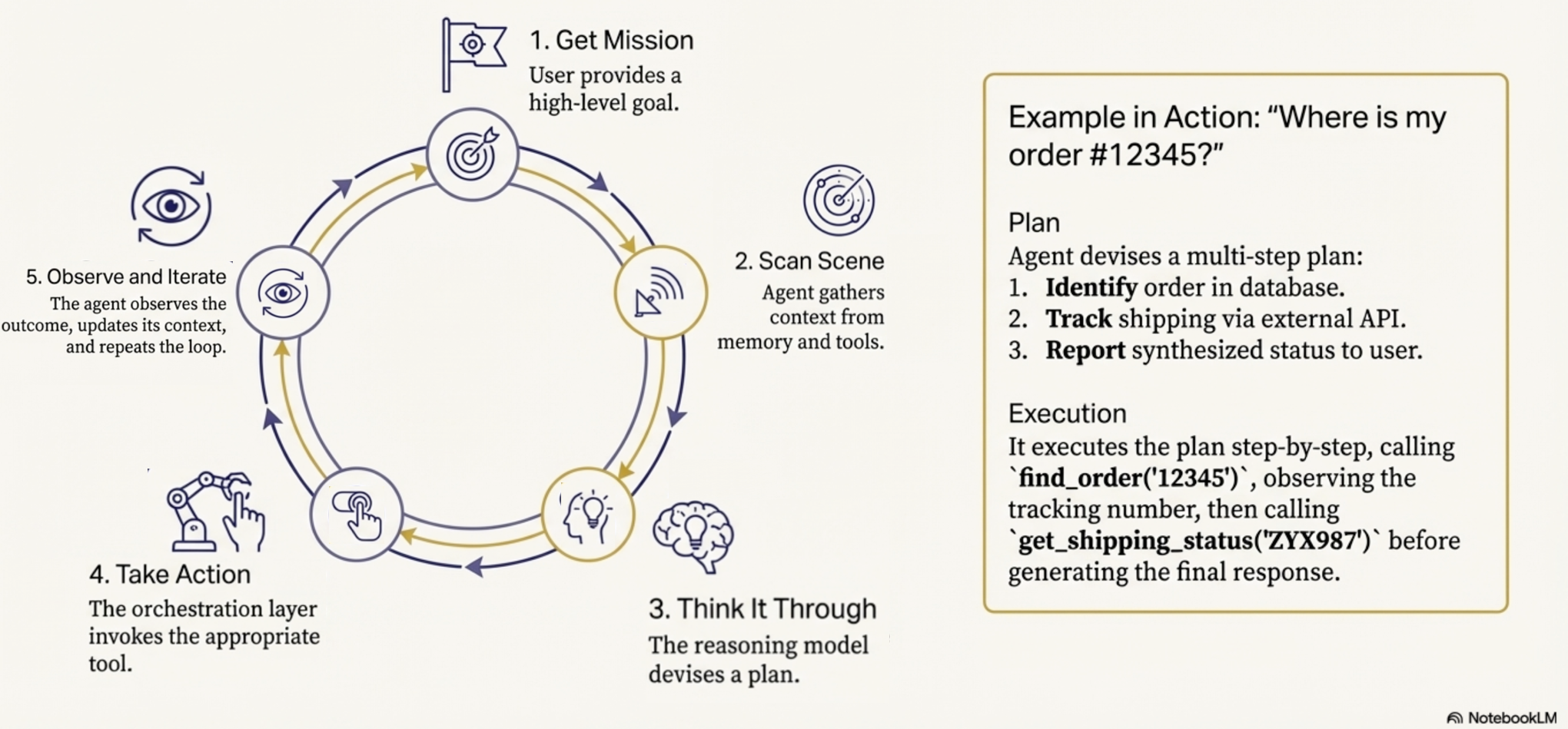
Get the Mission:
The process is initiated by a high-level goal (e.g., “Organize team travel”).
Scan the Scene:
The agent perceives its environment by accessing memory and available resources.
Think It Through:
The reasoning model analyzes the mission against the scene to devise a plan.
Take Action:
The agent executes a concrete step, such as an API call or database query. Observe and Iterate: The agent records the result of the action and feeds it back into the reasoning engine.
A Taxonomy of Intelligence
Classifying agents is critical when scoping projects to manage the trade-offs between system complexity and autonomous capability.
A central differentiator across these levels is Context Engineering:
Context Engineering: the art of context window curation
Context engineering
Context engineering is the modern evolution of what was formerly known as “prompt engineering”.
It is the practice of actively selecting, packaging, and managing the exact information a Language Model (LM) needs to generate a desired output.
For any single call to the LM, context engineering involves carefully curating the input window with a precise blend of elements like
system instructions,
user input,
available tools,
session history,
factual grounding from authoritative sources,
user profiles, and the
results of previously invoked tools
Key aspects of context engineering:
Optimizing the Model’s Attention:
An agent’s accuracy relies entirely on a focused, high-quality context.
Context engineering curates the model’s limited attention, preventing information overload and ensuring efficient, accurate performance.
The Core Function of an Agent:
In essence, AI agents are software systems dedicated entirely to the art of context window curation.
The Orchestration Layer manages a loop of
assembling this context,
prompting the model,
observing the results of any tool actions, and then
re-assembling a new, updated context for the next step.
Emergence in Strategic Problem-Solvers:
Context engineering is the defining skill that emerges in “Level 2” agentic systems (Strategic Problem-Solvers).
For example, if an agent is asked to find a good coffee shop halfway between two locations, it first finds the halfway point (e.g., Millbrae, CA). It then uses context engineering to automatically translate that observation into a new, highly focused search query (e.g.,
query="coffee shop in Millbrae, CA", min_rating=4.0) to complete the next step.
Continuous Autonomous Improvement:
“Enhanced Context Engineering” for self-evolving systems/agents.
The system autonomously and continuously refines its own prompts by learning from past experiences, session logs, and human feedback.
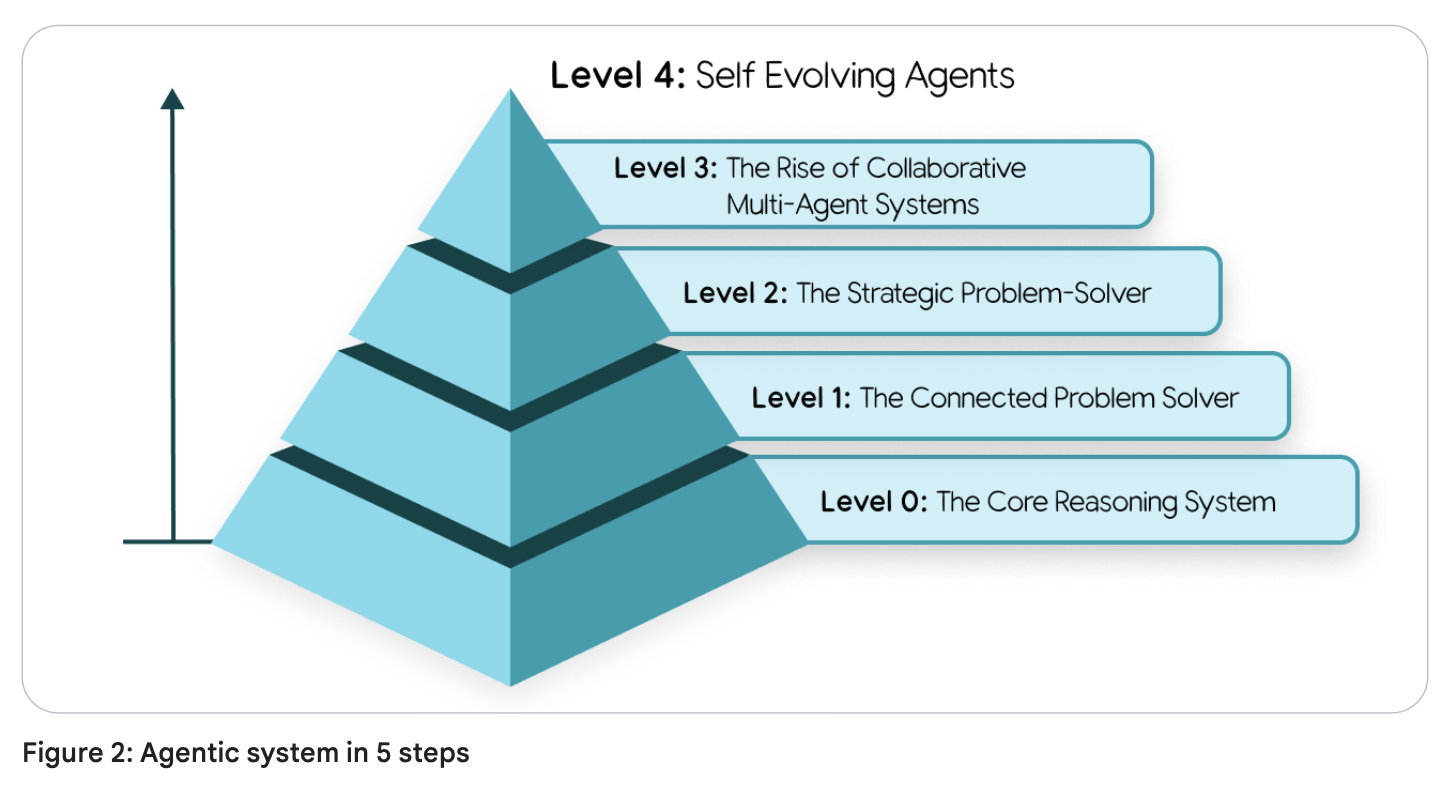
Levels 0-4 of Agentic Systems
 Source: Introduction to Agents; Authors: Alan Blount, Antonio Gulli, Shubham Saboo,
Michael Zimmermann, and Vladimir Vuskovic
Source: Introduction to Agents; Authors: Alan Blount, Antonio Gulli, Shubham Saboo,
Michael Zimmermann, and Vladimir Vuskovic
Level 0: The Core Reasoning System (The Isolated Brain)
A Language Model operating solely on pre-trained knowledge.
It is “blind” to real-time events (e.g., knowing baseball rules but not last night’s score)
Level 1: The Connected Problem-Solver (Retrieval/Tools)
The brain gains “hands.”
It uses the 5-step loop to access real-time data via search APIs or RAG (Retrieval-Augmented Generation)
Level 2: The Strategic Problem-Solver (Context Engineering)
The agent performs complex, multi-part goals.
It uses context engineering to select and package the most relevant data for each step
Enable proactive assistance and intent refinement
Level 3: The Collaborative Multi-Agent System (Division of Labor)
A “team of specialists” approach
A coordinator agent delegates missions to specialized sub-agents (e.g., Market Research vs. Web Dev), mirroring a human organization
Level 4: The Self-Evolving System (Autonomous Tool Creation)
The frontier. The system identifies capability gaps and autonomously creates new tools or agents (e.g., writing a new Python script to solve a novel math problem) to expand its own resources.
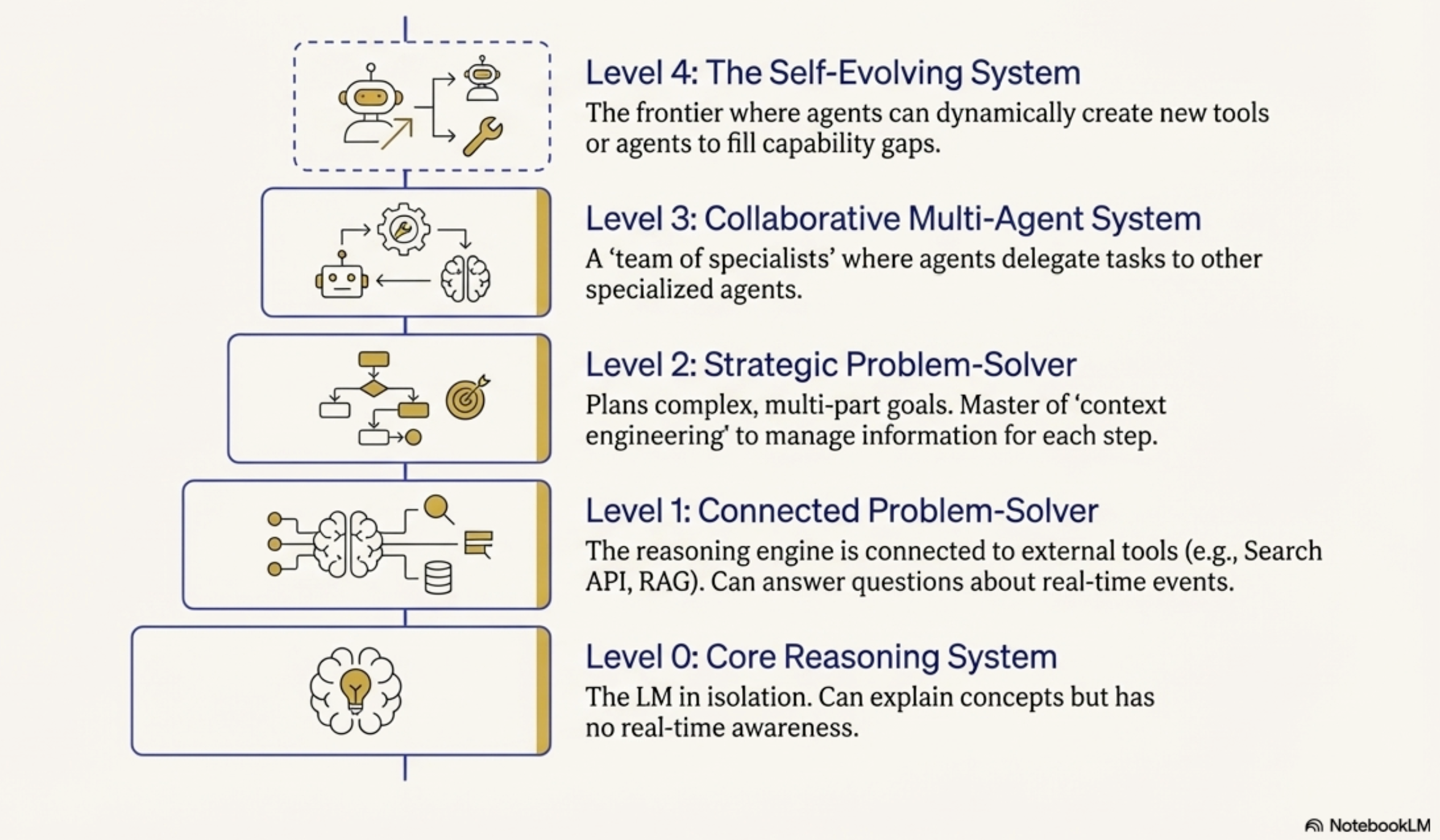
Moving through these levels requires a deep dive into the “Tripartite Architecture” of the Brain, Hands, and Nervous System.
The Core Anatomy: Model, Tools, and Orchestration
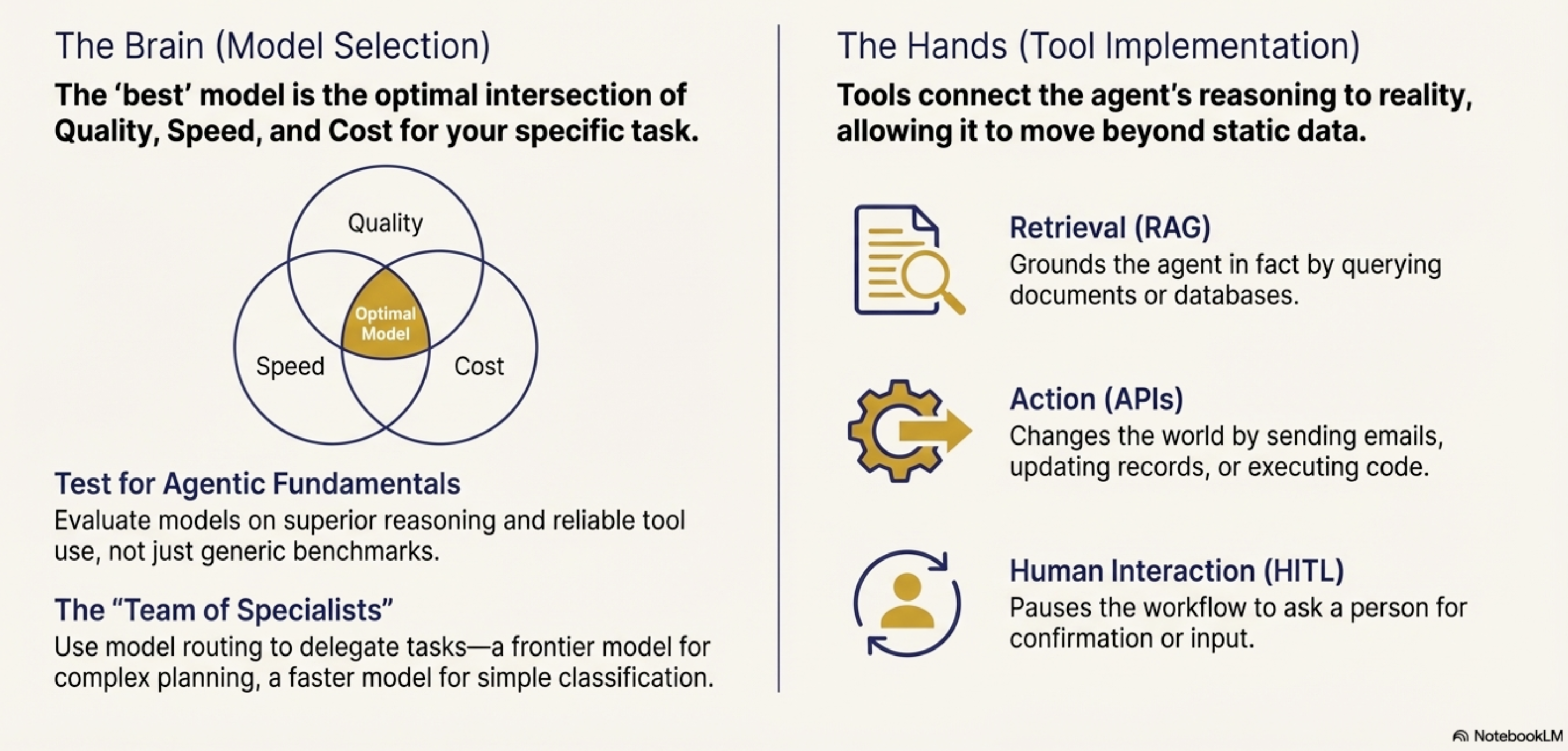
The Brain (The Model)
Benchmark scores are insufficient for agentic tasks
Success requires models that excel at reasoning and reliable tool use
Key considerations of a model in a AI agent:
Strategic Model Routing
Optimize the intersection of quality, speed, and price, architects should use a “team of specialists.”
A frontier model like Gemini 2.5 Pro should be routed for heavy-duty planning,
while the faster, more cost-effective Gemini 2.5 Flash handles intent classification and summarization.
This avoids the “sledgehammer” approach to simple tasks.
Cognitive Ceiling vs. Operational Cost
The model you choose today will be superseded in months
Building a nimble “Agent Ops” practice allows for upgrading the “Brain” without overhauling the entire architecture
The Hands (The Tools)
Tools provide the model’s connection to reality
These connections are categorized as:
Retrieving Information: Grounding the agent via RAG (Vector Databases) or NL2SQL (Structured Databases).
Executing Actions: Changing the world via APIs or Python sandboxes.
Computer Use: A critical frontier where the LM takes control of a user interface—navigating pages and pre-filling forms—often with Human-in-the-Loop oversight.
The Nervous System (The Orchestration Layer)
The orchestrator is the state machine governing the agent’s behavior (Spectrum of Autonomy)
Orchestration Layer
Engine that runs the “Think, Act, Observe” loop
Implementation: Ranges from deterministic, predictable workflows (AI as a tool) to “LM in the driver’s seat” (dynamic planning)
ADK: Code-first frameworks like the Agent Development Kit (ADK) provide the granular control and observability required for mission-critical enterprise systems
Agent Ops: Managing the Stochastic Lifecycle
Standard DevOps and software development rely on unit tests that check if an output perfectly matches an expected result,
This approach fails with the probabilistic nature of generative AI
Transition (from deterministic software to stochastic agentic systems) requires a new operational philosophy.
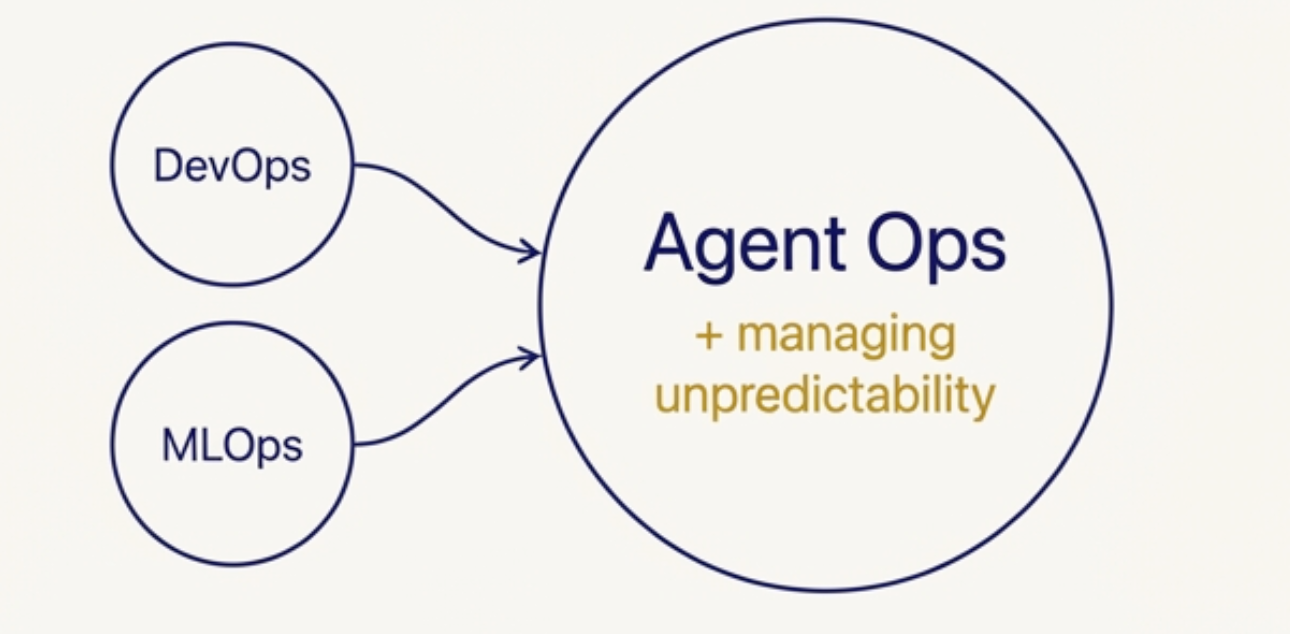
Agent Ops is the evolution of MLOps for managing this unpredictability
Agent Ops:
A disciplined, structured approach
Tailored to the unique challenges of building, deploying, and governing AI agents.
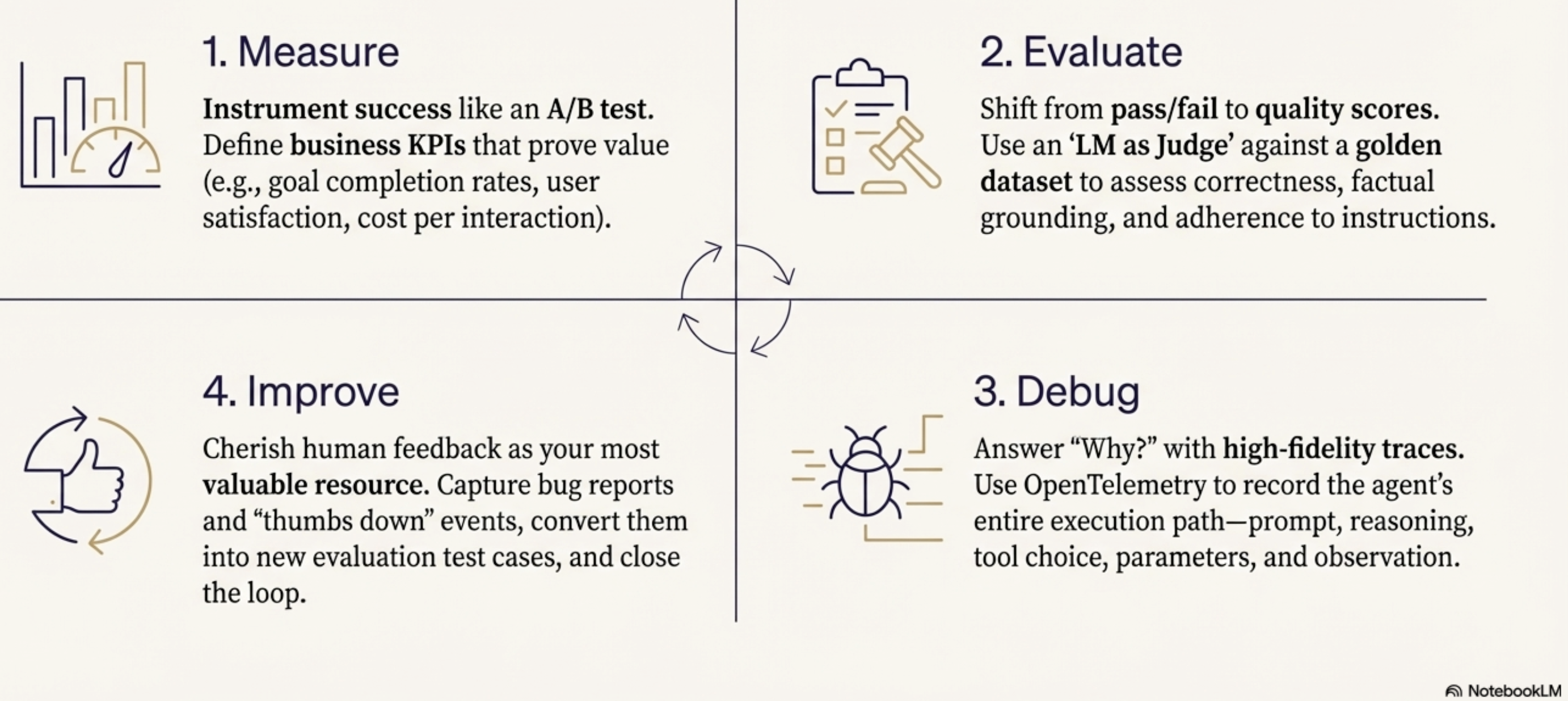
Agent Ops Toolkit
Measure
Measurement and KPI Tracking
Evaluate
“LM as Judge” for Quality Evaluation
Improve
Metrics-Driven Development
Debug
OpenTelemetry Traces
Human feedback
Measurement and KPI Tracking
Before an agent can be improved, its success must be defined like an A/B experiment
Success can be measured by business-aligned KPIs:
Goal completion rates,
User satisfaction scores,
Cost per interaction, and
Task latency.
Foundational tool in Agent Ops is a top-down observability strategy that tracks Key Performance Indicators (KPIs) mapping directly to business value.
Quality Assessment (LM as Judge)
Since pass/fail is impossible, a powerful model evaluates agent outputs against a Golden Dataset (curated prompts/responses) using a rubric (set of instructions or rules) for factuality and tone
Agent Ops replaces traditional unit tests with an “LM as Judge”
This involves using a powerful language model to assess the agent’s output against a predefined rubric, asking questions like:
Did it give the right answer?
Was it factually grounded? Did it follow instructions?
Metrics-Driven Development
Agent Ops utilizes these quality scores to create a “Go/No-Go” gate for deployments
When a developer makes changes, the new agent version is run against the entire evaluation dataset, and its scores are compared directly to the production version
For maximum safety, teams use A/B deployments to slowly roll out the new agent and compare real-world production metrics (like latency and cost) alongside the simulated scores
OpenTelemetry Traces
When metrics dip or a bug is reported, developers need to know exactly why the agent failed.
Agent Ops relies on OpenTelemetry traces, which provide a high-fidelity, step-by-step recording of the agent’s entire execution trajectory
Traces expose the full “thought process” of the agent, including:
The exact prompt sent to the model.
The model’s internal reasoning.
The specific tool it chose to invoke and the parameters it generated.
The raw data it observed in return
These detailed logs can be collected and visualized in platforms like Google Cloud Trace to streamline root cause analysis
Human feedback for closing the Loop
Human feedback (e.g., “thumbs down”) must be captured and converted into new permanent test cases in the evaluation dataset to prevent regression.
DevOps, MLOps, and GenAIOps
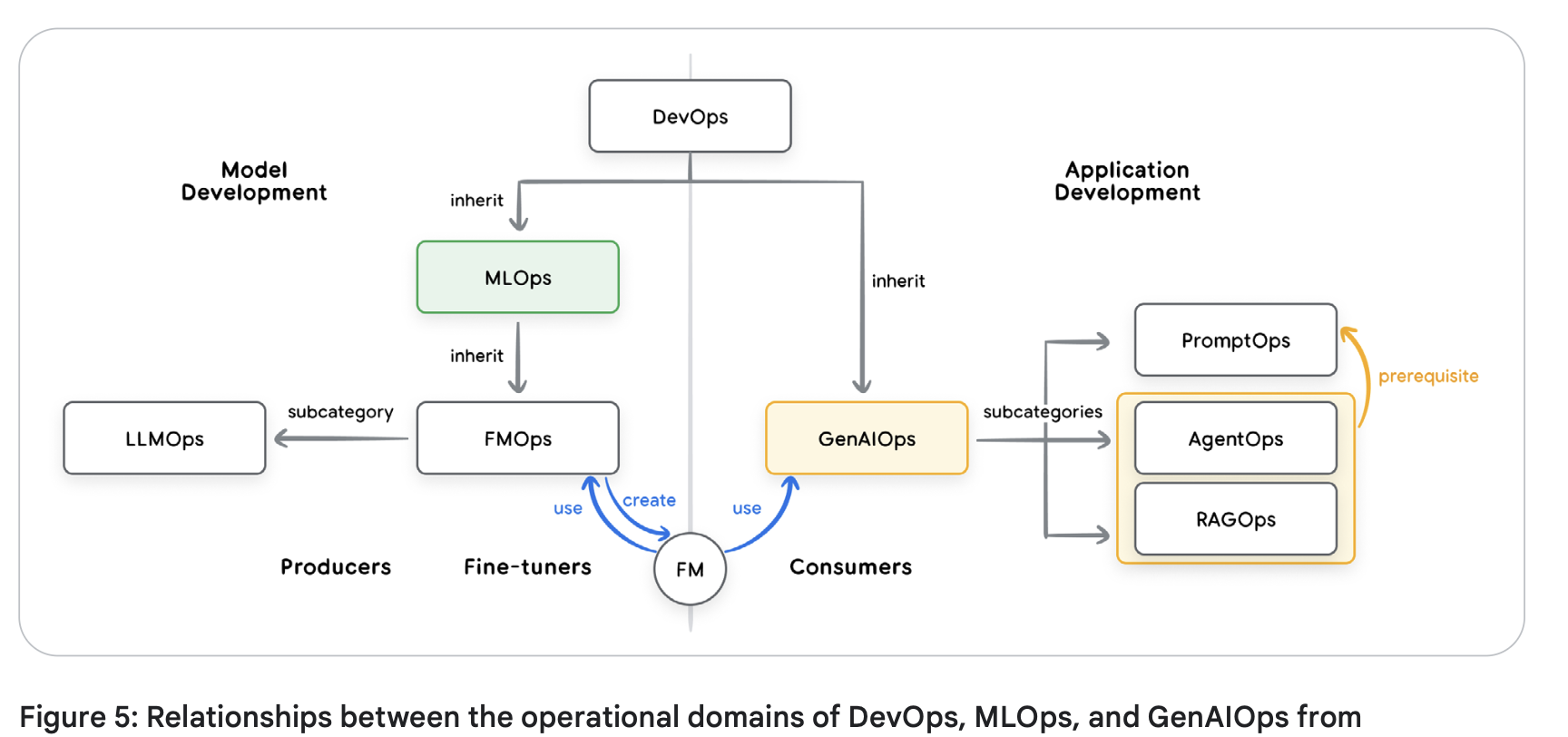 Source: https://medium.com/@sokratis.kartakis/genai-in-production-mlops-or-genaiops-25691c9becd0
Security and Governance: Hardening the Agentic Frontier
The “Trust Trade-Off” dictates that as agents gain autonomy, risk increases
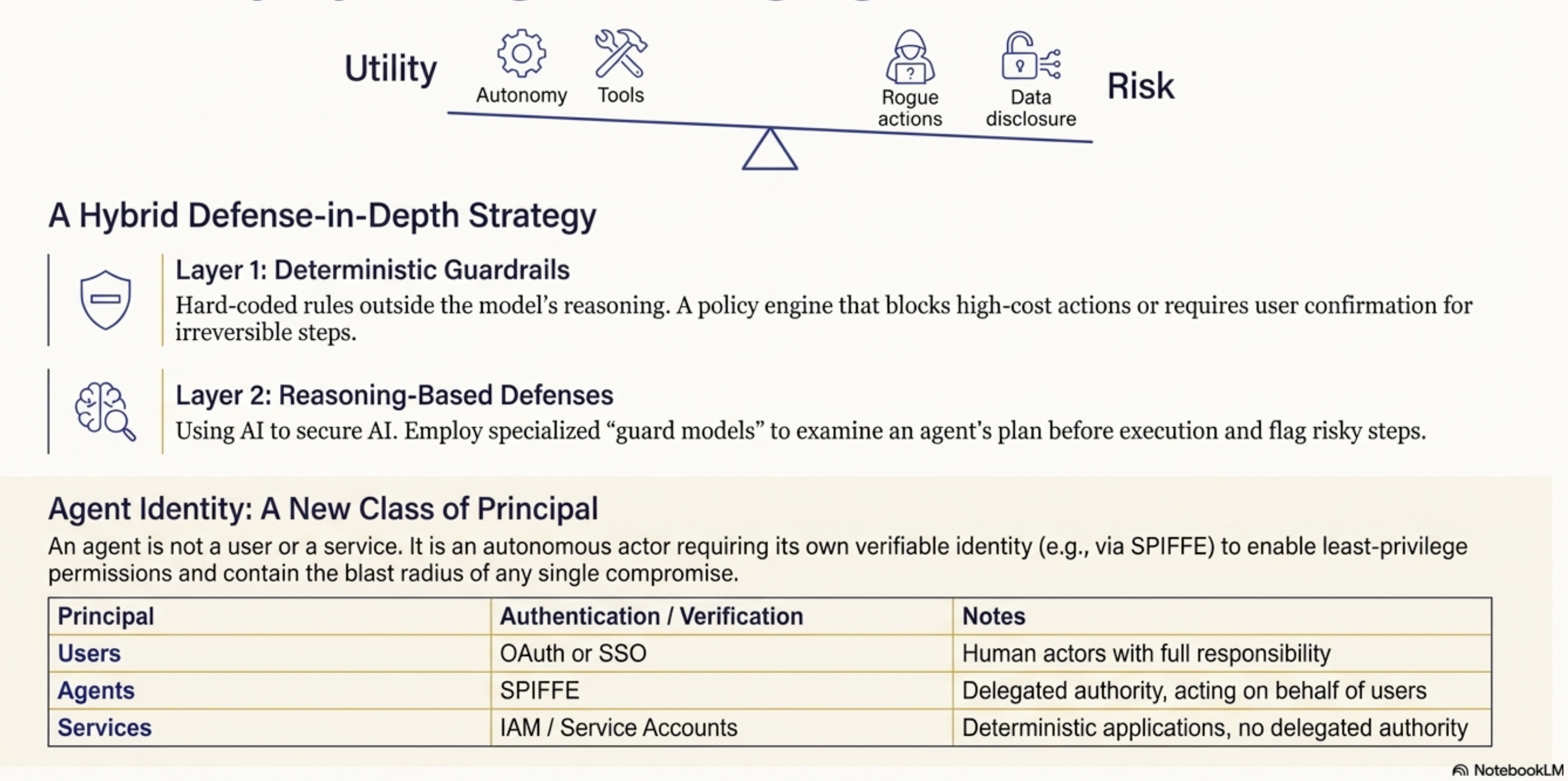
Hybrid Defense Strategy
Deterministic Guardrails
Hardcoded policy engines (e.g., “deny all DELETE commands”)
Reasoning-Based Defenses:
Managed services like Model Armor to screen prompts and plans for injection attacks, jailbreaks, and PII (Personally Identifiable Information) leakage.
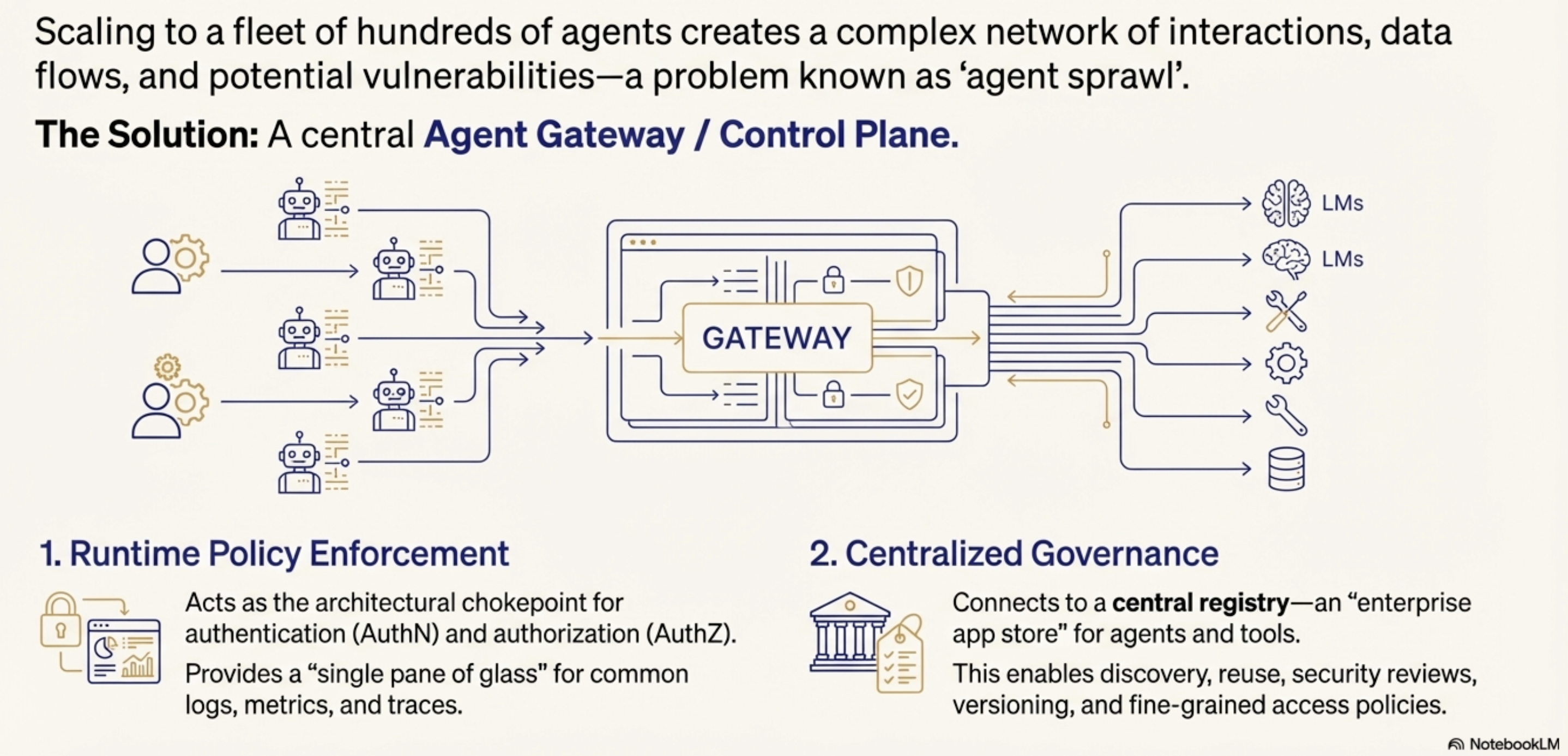
Governing the Agent Fleet
Control Plane:
Preventing “Agent Sprawl” through a centralized gateway and registry for runtime policy enforcement and discovery.
The Future: Self-Evolving Systems and Case Studies
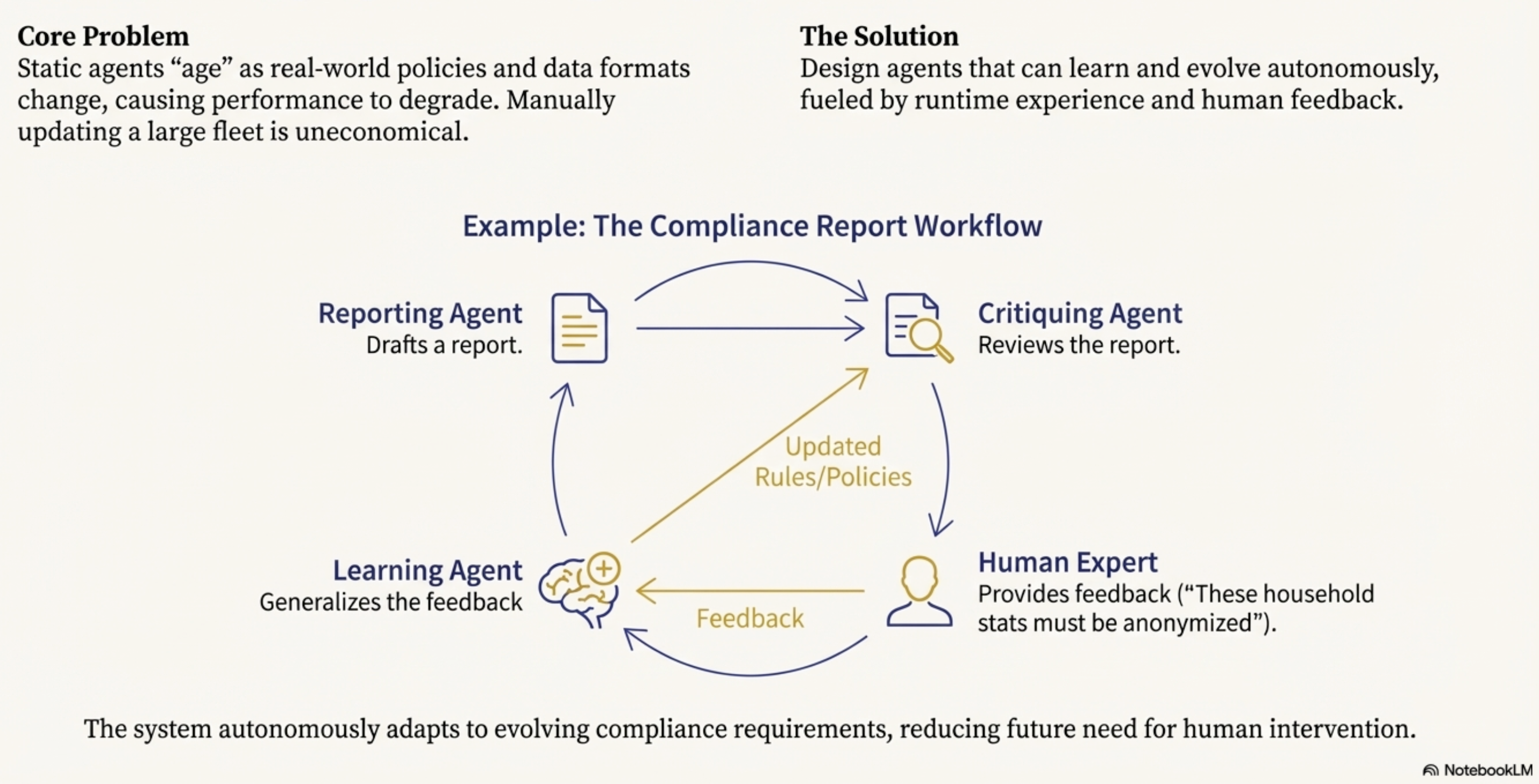
The final frontier; Learning Agent Loop
Combine runtime artifacts (logs/traces) and human feedback to autonomously refine context engineering and tool usage.
Agent Gym
A standalone, offline simulation environment that is not in the execution path.
It allows agents to “exercise” on synthetic data and pressure-test optimizations before production deployment.
Advanced Case Studies
Google Co-Scientist:
A multi-agent ecosystem where a “Supervisor” manages specialized agents to explore complex problem spaces, grounding scientific hypotheses in proprietary and public knowledge.
AlphaEvolve:
An evolutionary agentic system that generates human-readable code. It has achieved breakthroughs in improving Google’s data center efficiency, optimizing chip design, and discovering faster matrix multiplication algorithms.