Language Modeling Head (LM Head)
Objectives
Understand what a LM head is
Explore how LM head help predict the next token
What is LM head?
LM head projects the Context vector of the last token from the final block into the size of the model’s vocabulary and calculates a probability score for every possible next token
Enable next token prediction
Why LM head is important?
LM head is final component of a Transformer model, specifically in a LLM like GPT
Connects the output of the final Transformer block to the model’s vocabulary & help predict the next token
How is the LM head help predict next token
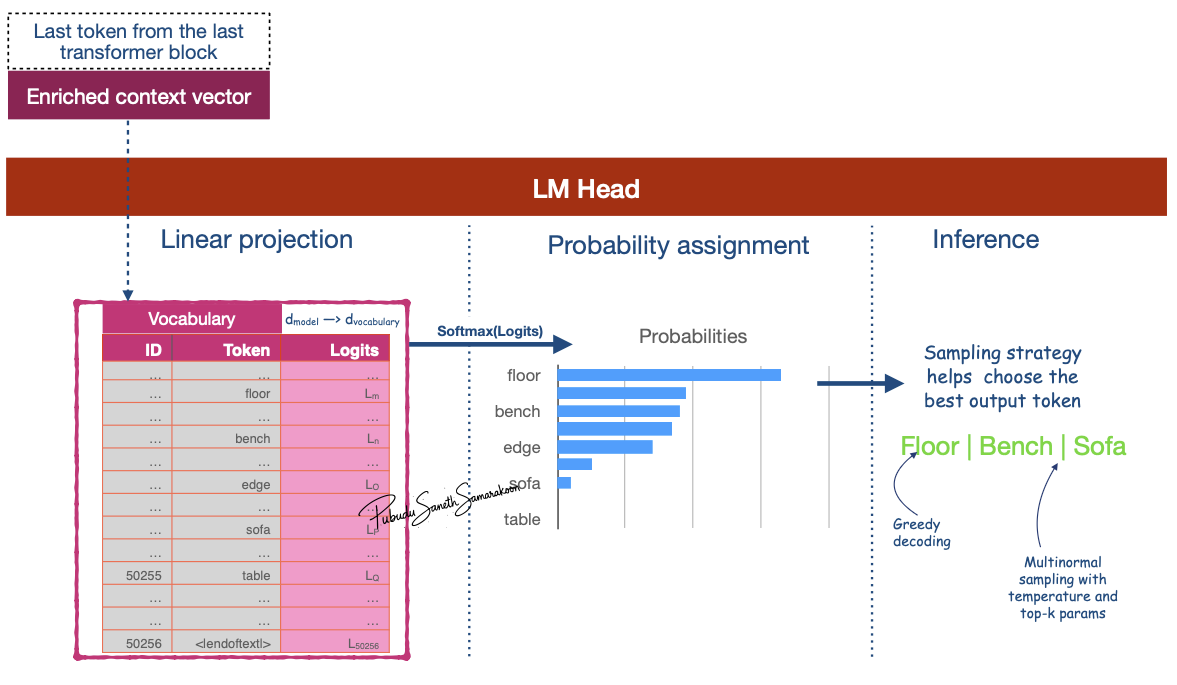
Input: Receives the “output vector” from the last Transformer block
E.g., if the model uses an embedding size of 3,072, the LM head takes in a vector of size 3,072 for each token.
Maps this input vector to a much larger vector equal to the size of the model’s vocabulary (e.g., 50,257 for GPT-2)
These outputs are raw, unnormalized scores called
logits
Convert
logitsto probability scores via softmax functionEmploy a sampling strategy to select the next token prediction
Coding
Custom LM-head
Steps:
Get Logits from the Language Modeling Head
Implement Temperature Scaling
Implement Top-K Sampling
Extract probabilities for Top-K
def lm_head(model, last_token_context_vector, temperature=0.7, k=50):


    # Get Logits from the Language Modeling Head
    ## Project matrix for d_model (model dimension) to d_vocabulary (vocabulary dimensions)
    lm_head = model.get_output_embeddings()
    ## Project last_token_context_vector and extract logits
    logits = lm_head(last_token_context_vector)

    # Implement Temperature Scaling
    # Lower temp -> more confident, less random. Higher temp -> more random, creative.
    scaled_logits = logits / temperature

    # Implement Top-K Sampling
    # We limit the sampling pool to the top 'k' most likely tokens
    top_k_logits, top_k_indices = torch.topk(scaled_logits, k)

    # Create a new tensor filled with a very low value (-inf)
    filtered_logits = torch.full_like(logits, -float("Inf"))
    # Scatter the top-k logits back into the new tensor at their original positions (Scatter the values along dimension 1)
    filtered_logits.scatter_(0, top_k_indices, top_k_logits)

    # Convert the filtered logits into a probability distribution
    probabilities = F.softmax(filtered_logits, dim=-1)
    return probabilities
Steps:
Decoding via multinomial sampling method to get the next token prediction
## Select top-n tokens from the probabilities calculated in the LM-head

def get_top_token(probabilities, tokenizer, top_n=1):

    # Sample one token from the final probability distribution
    # torch.multinomial is used for sampling from a discrete probability distribution.
    final_token_id = torch.multinomial(probabilities, num_samples=top_n)

    # Decode the selected token ID(s) to get the final word
    final_token = tokenizer.decode(final_token_id.tolist())

    print(f"\n✅ Final Selected {top_n} Tokens: '{final_token}'")
    return final_token
Note
Functions
lm_headandget_top_tokenused in GPT-2 pre-trained end to end exercise