Self-attention mechanism
Objectives
Gain a basic understanding of self-attention mechanism
Explore how attention weights are calculated & how context vector is generated.
What is self-attention mechanism?
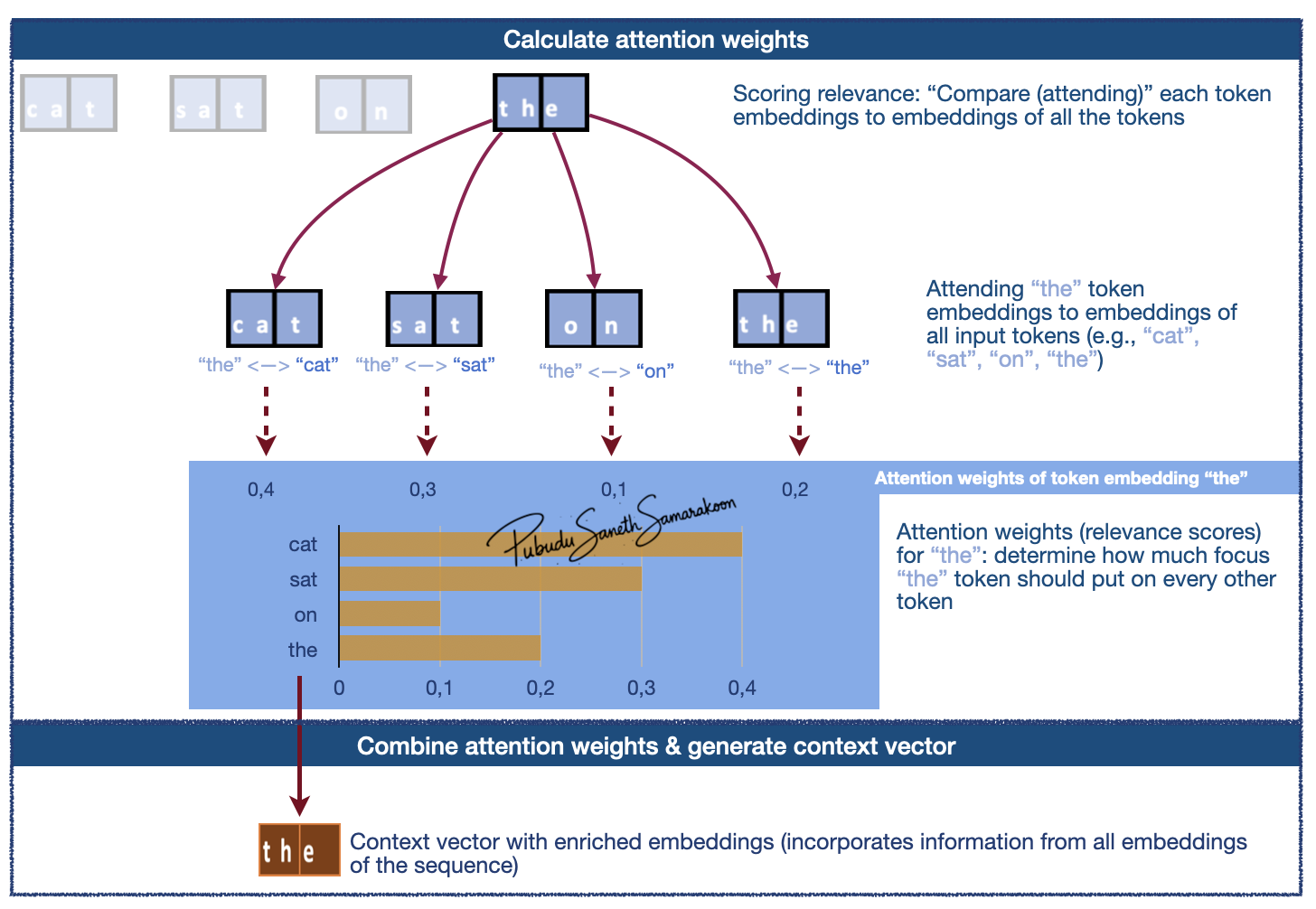
Self-attention: create a new, enriched representation (context vector) by incorporating information from all token embeddings in the sequence
Two main steps mechanism:
Scoring relevance (“attending to”/”considering” all tokens) & calculate attention weights (relevance scores)
Combine attention weights and generate context vector (new enriched representation)
Context vector (context-aware representation / enriched representation):
Captures the specific meaning of a token embeddings within its surrounding embeddings
Allow the model to understand relationships and dependencies between words, regardless of how far apart they are in the sentence
Understanding self-attention with Q, K, V weight matrix
Overview of self-attention with Q, K, V weight matrix
Note
Key concepts of attention mechanism
Q (Query), K (Key) and V (Value) roles input token embeddings play in attention mechanism
Q, K, V projection via learnable projection matrices (\(W_{k}\), \(W_{q}\), \(W_{v}\))
Attention scores and Attention weights
Context vectors
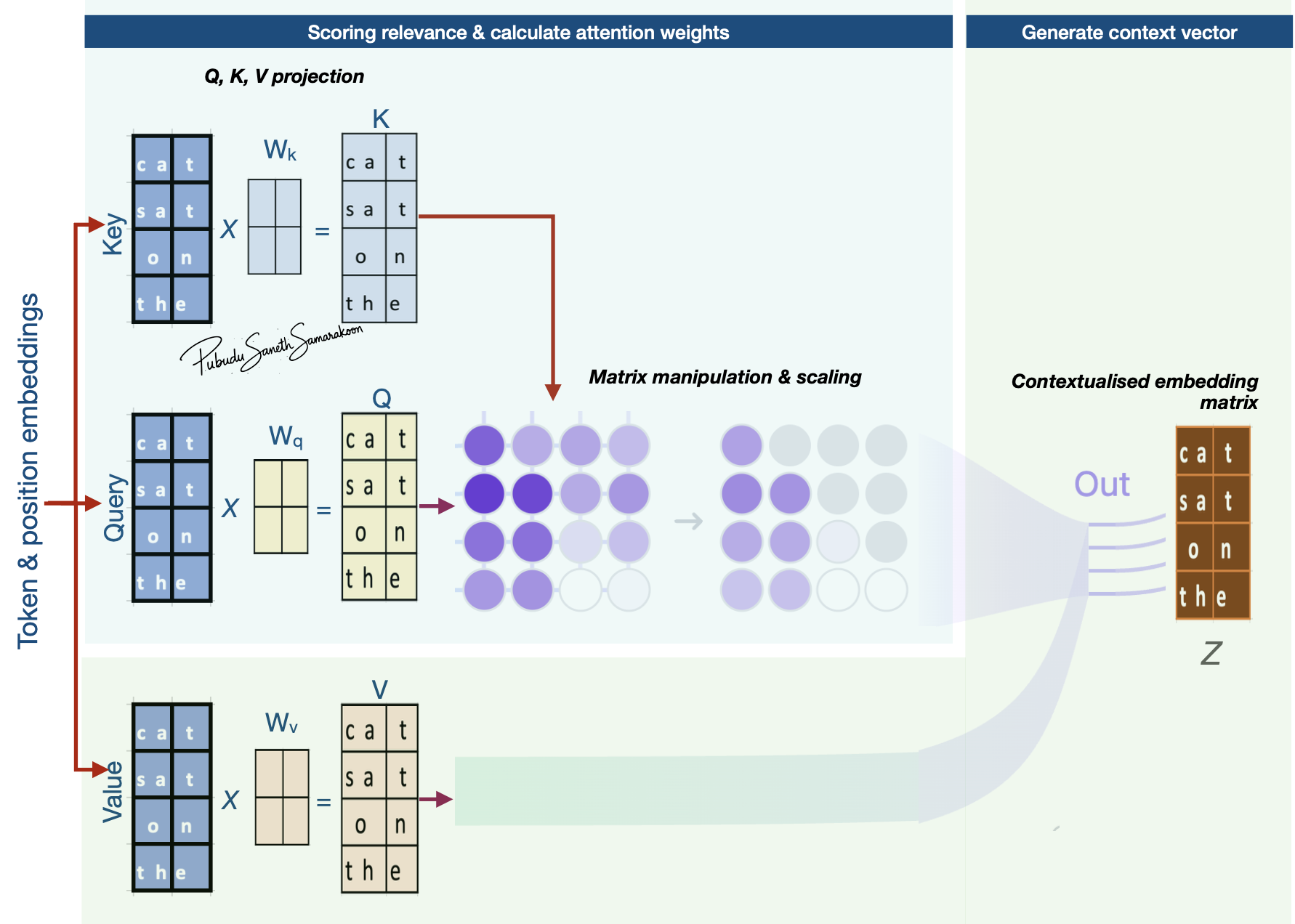 Source (modified): transformer-explainer
Queries (Q), Keys (K), and Values (V)
Three roles of input token embeddings: Queries (Q), Keys (K), and Values (V):
Input token embeddings play three distinct roles in the attention mechanism
Queries (Q) “attend” to other vectors in the input sequence and serve as starting points to generate context vectors
Keys (K) gets compared to (matched with) Queries (Q) when calculating attention scores (relevance scores)
Values (V) serve as “reference values” that summarize scores from all-vs-all Q and K matching
Q, K, V projection:
First step in attention mechanism is to project Q, K, V embeddings to \(𝑄_{𝑚𝑎𝑡𝑟𝑖𝑥}\), \(K_{𝑚𝑎𝑡𝑟𝑖𝑥}\) and \(V_{𝑚𝑎𝑡𝑟𝑖𝑥}\) representations via a learnable projection matrices
\(𝑄_{𝑚𝑎𝑡𝑟𝑖𝑥}\): Vectors that “attend” to other vectors in the input sequence. (Actual vectors that are used as queries for the “comparison / attention”)
\(𝐾_{𝑚𝑎𝑡𝑟𝑖𝑥}\): Vectors that get compared to queries
\(V_{𝑚𝑎𝑡𝑟𝑖𝑥}\): Vectors that are used to combine values from previous step and generate context vector
\(𝑄_{𝑚𝑎𝑡𝑟𝑖𝑥}\), \(K_{𝑚𝑎𝑡𝑟𝑖𝑥}\) and \(V_{𝑚𝑎𝑡𝑟𝑖𝑥}\) have similar dimensions to Q, K, V embeddings, but the values in these matrices can get updated during the model training (due to the learnable projection matrices: \(W_{q}\), \(W_{k}\) and \(W_{v}\))
Learnable projection matrices: \(W_{q}\), \(W_{k}\) and \(W_{v}\)
Without these projection matrices, the relationship between embeddings would be static
The learnable matrices ensure that the attention mechanism is dynamic and allows \(𝑄_{𝑚𝑎𝑡𝑟𝑖𝑥}\), \(K_{𝑚𝑎𝑡𝑟𝑖𝑥}\) and \(V_{𝑚𝑎𝑡𝑟𝑖𝑥}\) get updated in model training
Allow the model to learn how to interpret embeddings differently depending on their context in the input sequence
Learnability allow the model to discover and optimize complex linguistic patterns during training
Attention weights:
Attention weights are calculated by:
Multiplies the Query vectors by the all the Key vectors in the sequence
Scale these scores
Convert scaled scores to probabilities
These probabilities (attention weights) help model determine how much focus the current token should put on other tokens
Context vector
Once attention weights are calculated, the model uses them to aggregate information.
The result is a new, enriched vectors that contain context from the relevant parts of the sequence
Understanding attention equation (scaled Dot-Product Attention)
Attention scores: (\({QK^T}\))
Attention weights: \(softmax(\frac{QK^T}{\sqrt{d_k}})\)
Context vector calculation: \(softmax(\frac{QK^T}{\sqrt{d_k}})*V\)
Attention weights calculation: \(softmax(\frac{QK^T}{\sqrt{d_k}})\)
Three stage Attention weights calculation process:
Stages 1: Calculate attention score with
dot product(\({QK^T}\))Stage 2: Scaling (\(\frac{QK^T}{\sqrt{d_k}}\))
Stage 3: Calculate “Attention weights” (\(softmax(\frac{QK^T}{\sqrt{d_k}})\))
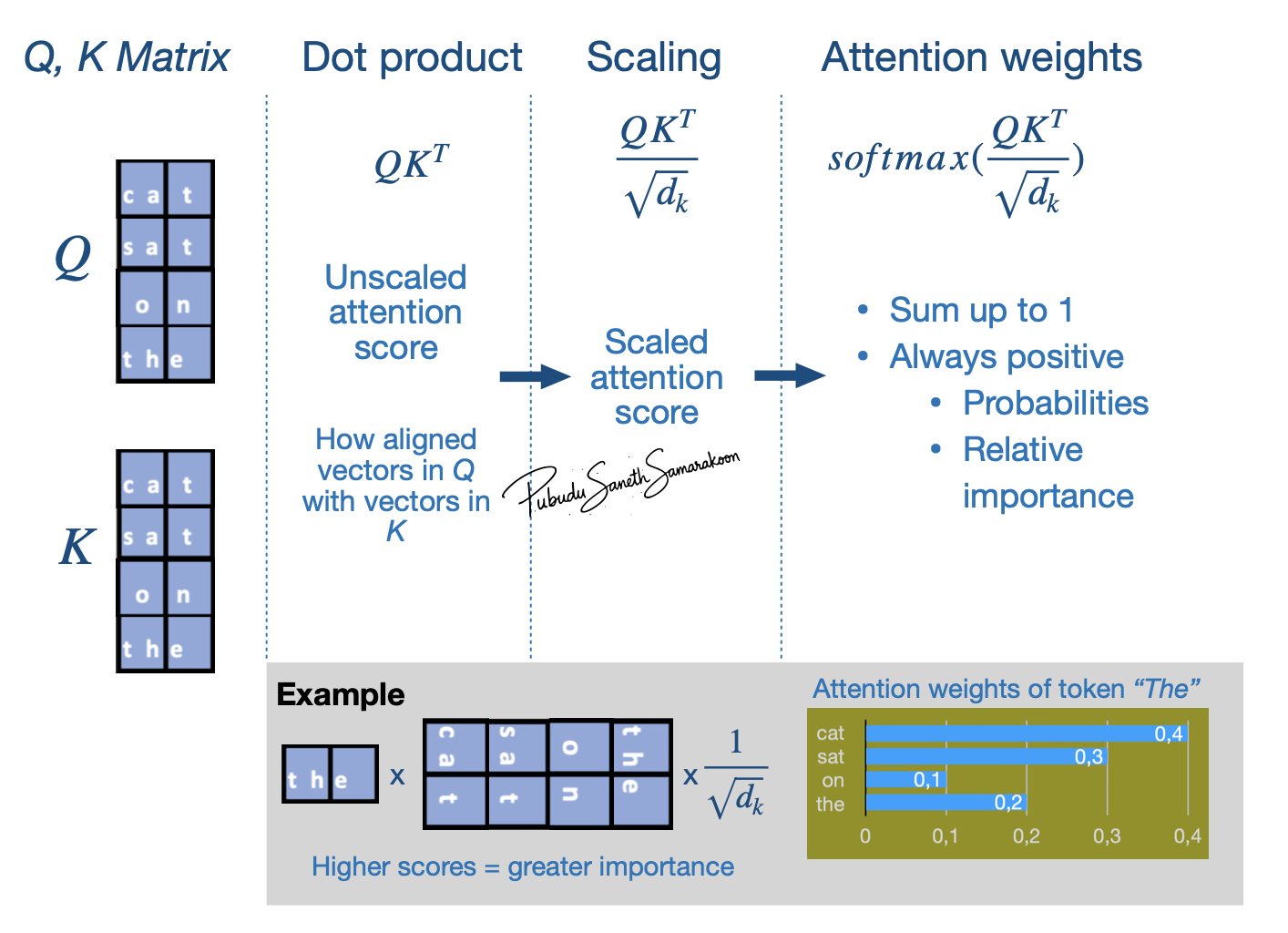
Stages 1: Calculate attention score with dot product (\({QK^T}\)):
Provides unscaled attention score (initial relevance scores) - A higher dot product means the two tokens are more aligned (similar context)
Indicates how aligned vectors in \(𝑄_{𝑚𝑎𝑡𝑟𝑖𝑥}\) with vectors in \(𝐾_{𝑚𝑎𝑡𝑟𝑖𝑥}\)
i.e., how much focus \(𝑄_{𝑚𝑎𝑡𝑟𝑖𝑥}\) vectors should put on \(𝐾_{𝑚𝑎𝑡𝑟𝑖𝑥}\) vectors
Matrix manipulation enables simultaneously compare all the vectors in \(𝑄_{𝑚𝑎𝑡𝑟𝑖𝑥}\) to \(𝐾_{𝑚𝑎𝑡𝑟𝑖𝑥}\)
Stage 2: Scaling (\(\frac{QK^T}{\sqrt{d_k}}\)):
Scaled attention scores
Help avoid high-values in attention score and stabilize gradients
Stage 3: Calculate “Attention weights” (\(softmax(\frac{QK^T}{\sqrt{d_k}})\)):
Apply
softmaxfunction to scaled attention scores and calculate “Attention weights”softmaxfunction makes values to be positive and sums up 1 (convert to probabilities)i.e., Convert attention scores to attention weights (probabilities) what shows “relative importance” \(𝑄_{𝑚𝑎𝑡𝑟𝑖𝑥}\) vectors put on \(𝐾_{𝑚𝑎𝑡𝑟𝑖𝑥}\) vectors
Main Stages: \(softmax(\frac{QK^T}{\sqrt{d_k}})*V\)
Multiply these attention weights by the Value vectors (\(V_{𝑚𝑎𝑡𝑟𝑖𝑥}\)) and produce final context vector
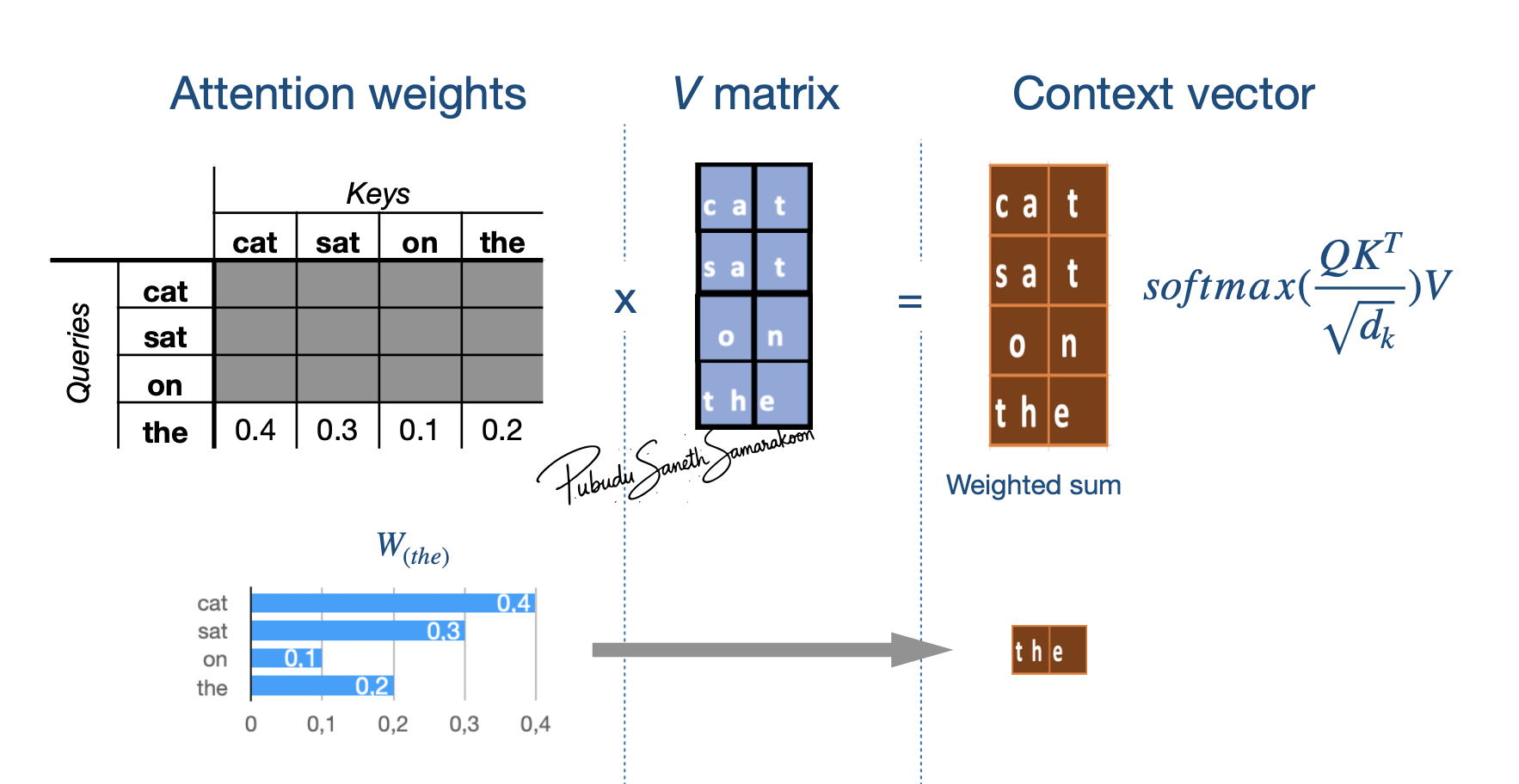
\(𝑊_{𝑡ℎ𝑒}\): To what extent token “the” attend to (focus on) each input token (attention weights)
\(𝑉_{𝑚𝑎𝑡𝑟𝑖𝑥}\): Representation of input token embedding matrix